What is Balcony Soffit Cladding?
A Complete Guide for Specifiers, Fabricators & Developers
The balcony soffit is the underside surface of a projecting balcony. The horizontal face that sits directly below the deck and faces down towards the building or ground. On most steel bolt-on and slide-on balconies, this area is often left exposed during fabrication, revealing the structural steelwork, drainage channels, and fixings beneath. Without cladding, it can be an eyesore. With the right balcony soffit cladding system, it becomes a clean, compliant, and architecturally resolved element of the balcony design.
This guide explains what balcony soffit cladding is, why it matters, what UK building regulations require, and how to choose the right system for your project, whether you are a steel fabricator, architect, specifier, main contractor, or developer. Last updated: April 2026
1. What is a balcony soffit?
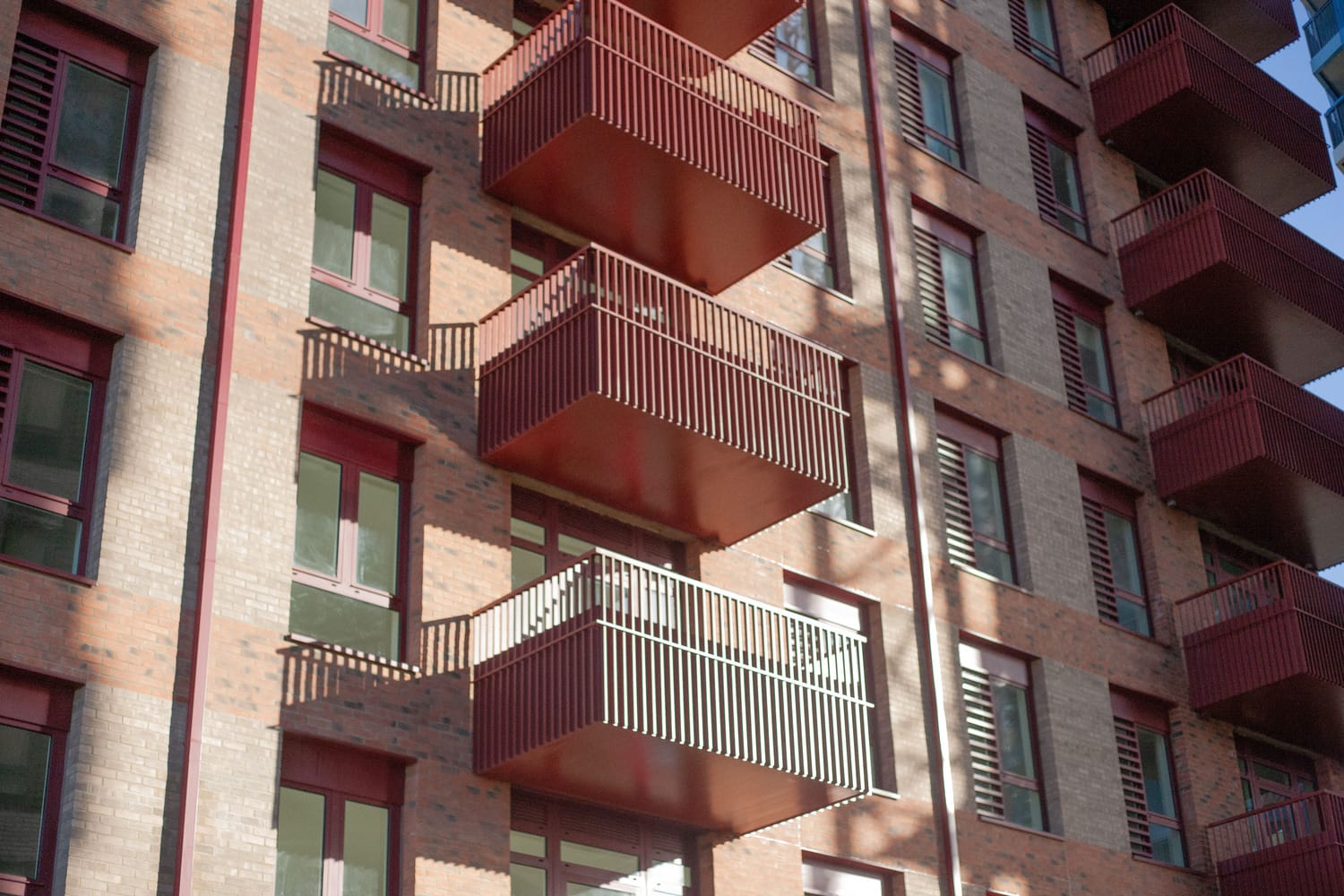
In construction terminology, a soffit is the underside of any architectural element. A beam, staircase, arch, or in this context, a balcony. The balcony soffit is the horizontal surface formed by the underside of the balcony deck and its structural frame as it projects outward from the building facade.
On steel cantilever balconies, by far the most common type in UK multi-storey residential and commercial construction. The soffit is typically left open during the fabrication and installation of the balcony frame. The steel beams, joists, fixings, and in many cases drainage pipework are all visible from below. Soffit cladding is the system used to close off and finish this underside, creating a clean and cohesive appearance while also delivering practical benefits in terms of fire performance and water management.

2. Why balcony soffit cladding matters
Aesthetics and architectural finish
The underside of a balcony is highly visible from street level, from neighbouring properties, and from the external walkways and communal areas of the building itself. An uncladded soffit, with exposed steelwork, drainage pipes, and fixings, presents a poor aesthetic that undermines the quality of the overall building. Soffit cladding delivers the clean, resolved finish that architects, developers, and building owners expect from a quality project.
Fire performance and regulatory compliance
Following the Grenfell Tower fire in 2017, UK building regulations introduced sweeping changes to the fire safety requirements for external walls and associated elements, including balconies. Approved Document B (Fire Safety) and the Building (Amendment) Regulations 2018 introduced requirements for non-combustible materials in the external walls of relevant buildings. These requirements extend to balcony soffits, which form part of the external envelope and can act as pathways for fire spread between floors if constructed from combustible materials.
A non-combustible aluminium soffit cladding system, fire-rated to A2-s1, d0 in accordance with BS EN 13501-1, satisfies these requirements and provides the evidence trail that specifiers, contractors, and building safety assessors require.
Water management
Balconies are exposed to rainfall throughout the year. For balconies where drainage is not managed at deck level, for example, where there are gaps between decking boards or where a drainage channel runs at the perimeter, water falls through the deck and collects on the balcony frame below. Without soffit cladding, this water simply drips freely from the balcony underside, which can cause staining, corrosion, and water ingress into the floors below. An integrated drainage soffit cladding system captures this water and directs it to a controlled outlet point, protecting the structure and the building below.

3. What UK building regulations require
The regulatory landscape for balcony soffit cladding has evolved significantly since 2018 and continues to tighten. Specifiers and fabricators must understand the current position and plan for the direction of travel.
The combustible materials ban
Regulation 7(2) of the Building Regulations, introduced in December 2018, prohibits the use of combustible materials in the external walls of relevant buildings, defined as residential buildings over 18 metres in height. This ban explicitly extends to balconies and their components, including soffit cladding. Materials must be classified A1 or A2-s1, d0 under BS EN 13501-1 to comply. This rules out timber, uPVC, composite, and untreated steel soffit solutions on affected buildings.
The 11 metre threshold
Amendments to Approved Document B, effective from March 2025, extended non-combustibility requirements to balconies on residential buildings over 11 metres. This significantly broadens the scope of projects where compliant soffit cladding is now mandatory, effectively covering most multi-storey residential developments. Many developers and specifiers now apply non-combustible specifications as standard across all building heights as a matter of future-proofing and risk management.
Regulatory summary
Buildings over 18m: A1 or A2-s1, d0 soffit cladding mandatory under Regulation 7(2).
Buildings over 11m: A1 or A2-s1, d0 now required under AD B (2025 amendments).
Buildings under 11m: Non-combustible materials increasingly specified as standard best practice.
EWS1 and remediation
The EWS1 process, the External Wall System fire review used in the assessment and sale of flats in multi-storey buildings, has brought significant scrutiny to balcony undersides as part of the broader external wall system assessment. Non-compliant timber or composite soffit cladding on existing buildings is a common issue requiring remediation. An aluminium soffit cladding system provides a compliant, off-the-shelf replacement solution that satisfies assessors and unlocks EWS1 sign-off.

4. Why aluminium is the material of choice
Aluminium is the dominant material for compliant balcony soffit cladding in the UK for a combination of practical, regulatory, and environmental reasons.
| Property | Why it matters for soffit cladding |
|---|---|
| Fire performance | A2-s1, d0 rated — satisfies Regulation 7(2) and AD B on all relevant buildings. |
| Durability | 60-year design life. 30-year warranty* (postcode dependent). Zero maintenance beyond periodic cleaning. No rotting, warping, splitting, or splintering. |
| Weight | High strength-to-weight ratio. Light enough for fast installation without additional structural loading. |
| Recyclability | Aluminium is infinitely recyclable. AliClad achieves a 96.4% end-of-life recycling rate, verified by third-party EPD. |
| Off-the-shelf availability | Modular, kit-form systems remove the need for bespoke fabrication, folding machines, or punch tools. Significant time and cost savings on site. |
| Finish quality | Powder-coated to Qualicoat-accredited standard. Available in any RAL colour. Long-lasting, consistent appearance. |

5. Types of aluminium balcony soffit cladding
Not all balconies have the same requirements. The right soffit cladding system depends on how drainage is managed, the aesthetic specification, the budget available, and the complexity of the project. There are three principal categories of aluminium soffit cladding:
Free-draining soffit cladding
Free-draining systems use open-gap aluminium boards that allow water to pass freely through the soffit and drip from the balcony underside. This is the simplest and most cost-effective approach, and is appropriate for balconies where drainage is fully managed at deck level, for example, where the decking boards are gapped and water is directed to a perimeter channel or outlet before it reaches the soffit. Free-draining systems conceal the structural steelwork and deliver a clean underside finish without the additional complexity of a drainage channel.
Sealed soffit cladding
Sealed systems use interlocking aluminium boards that form an imperforate layer across the balcony underside. This creates a fully enclosed soffit with strong visual impact, and also provides an important fire safety benefit: the imperforate layer limits the spread of fire and smoke in the soffit void, helping to contain compartment boundaries. Sealed soffit cladding is suitable for balconies where deck-level drainage captures all water before it reaches the soffit plane.
Integrated drainage soffit cladding
Drainage-integrated systems combine the cladding board with a built-in water management channel. The boards are designed to fall at a recommended gradient, typically 1:80, directing any water that enters the soffit void towards a perimeter gutter profile from which it is evacuated in a controlled manner. This is the appropriate solution for balconies where drainage cannot be fully resolved at deck level, and where falling water from the balcony underside would cause damage to the building or lower balconies. Integrated drainage systems are more complex to install but provide a fully resolved solution for challenging drainage scenarios.


6. Choosing the right AliClad system for your project
AliClad is the leading off-the-shelf aluminium balcony soffit cladding system in the UK, developed through continuous innovation by AliDeck from its facility in Rochester. The AliClad range offers four distinct products covering every project requirement, from budget-driven schemes to premium architectural specifications.
| System | Category | Best for | Key feature |
|---|---|---|---|
| AliClad Eco (coming soon) | Drainage Integrated | Budget-led projects, working in conjunction with deck level drainage | Most cost-effective system in the range. Less aluminium, lower embodied carbon, same A2-s1, d0 fire rating. |
| AliClad Lite | Free-draining | Cost-effective open-gap finish | Simple extruded board, direct fix to steel framework. Ultra-fast installation. |
| AliClad Decor | Sealed | Premium aesthetic, imperforate layer | Box-section interlocking board with hidden fixings. Striking visual impact. Fire containment benefit. |
| AliClad Flow | Drainage-integrated | Works in conjunction with deck level drainage acting as a positive drainage solution | Built-in channel drain at 1:80 fall. Captures and evacuates water in a controlled manner. |
All four AliClad products are constructed from 6063 T6 grade aluminium, fire-rated to A2-s1, d0, powder-coated to Qualicoat-accredited standard, and supplied with a 30-year product warranty. All are manufactured in the UK.

7. Sustainability and environmental credentials
Sustainability requirements are increasingly central to UK construction specifications, with BREEAM credits, whole-life carbon assessments, and net zero commitments all influencing material selection. AliClad is able to support these requirements with market-leading environmental credentials.
Environmental Product Declaration
AliClad is one of the very few balcony soffit cladding systems in the UK to hold a published, third-party verified Environmental Product Declaration (EPD). Published in February 2026 and valid until February 2031, the AliClad Cladding EPD (EPD Hub, HUB-5511) is produced in accordance with EN 15804+A2 and ISO 14025 and independently verified. It provides verified environmental impact data across the full product lifecycle, from raw material extraction through to end-of-life recycling.
AliClad EPD — headline environmental data (per m² of soffit cladding system)
GWP-total A1-A3: 62.3 kg CO₂e/m²
Recycled content (inputs): 38.4%
Recyclability at end of life: 96.4%
Module D recycling credit: -30.2 kg CO₂e/m²
REACH SVHC compliant
EPD Hub HUB-5511, EN 15804+A2 & ISO 14025
Circular economy credentials
Aluminium is one of the most recyclable materials in the built environment. At end of life, 96.4% of AliClad by mass is recovered and recycled, with the associated carbon credit of -30.2 kg CO₂e per m² captured in Module D of the EPD. This supports whole-life carbon assessments and helps projects demonstrate strong circular economy credentials.
UK manufacture
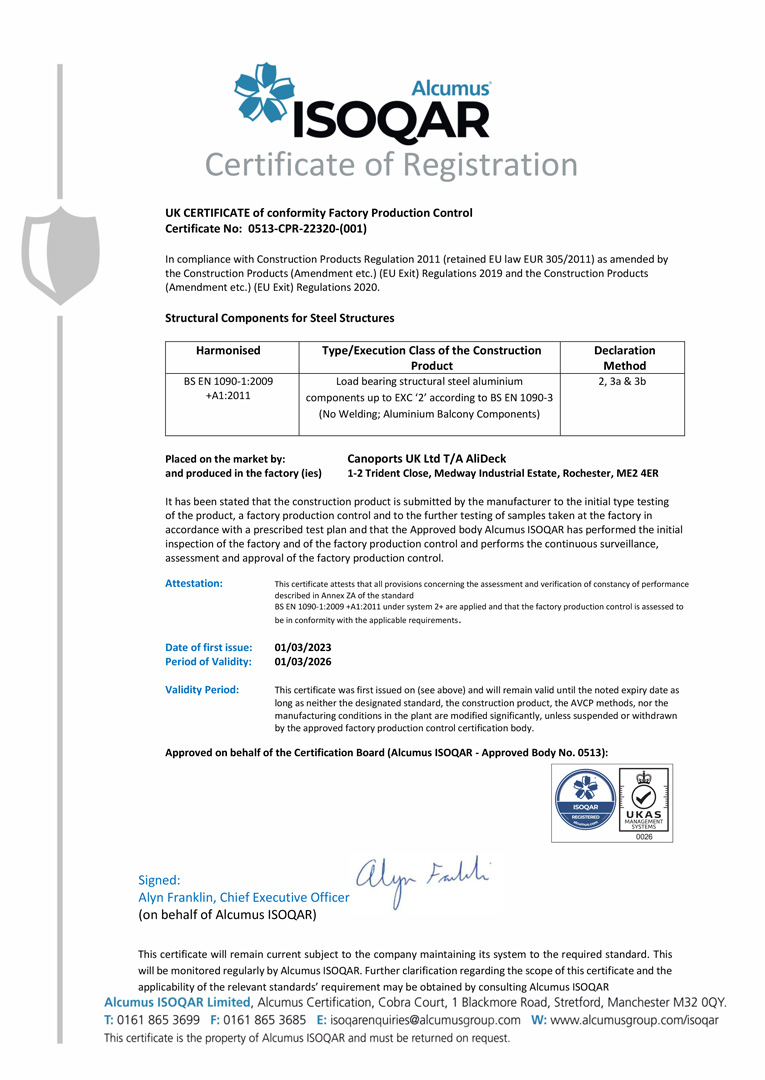
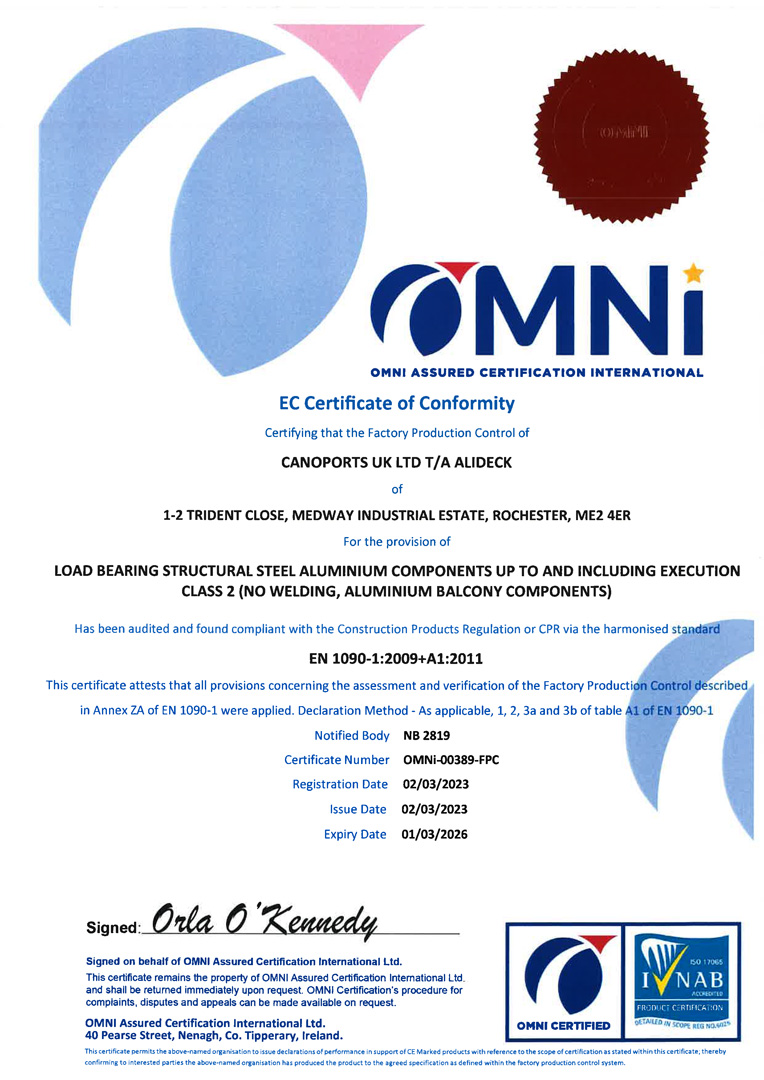
AliClad is manufactured entirely at AliDeck’s facility in Rochester, Kent. Raw aluminium is UK-sourced. This ensures full supply chain traceability, shorter transport distances, reduced logistics carbon, and a shorter, more reliable lead time than overseas suppliers. AliDeck holds UKCA and CE certifications, awarded in 2023, providing formal documentation of product conformity for both UK and European markets.

8. AliClad: innovation and manufacture
AliClad is the result of a sustained programme of product innovation rooted in AliDeck’s decades of experience in aluminium extrusion and balcony component design. The AliClad range was developed in direct response to the needs of steel fabricators, who historically relied on bespoke folded sheet metal or custom flat panels to close off balcony undersides, a time-consuming, expensive, and often inconsistent approach.
AliDeck’s engineering team continuously develops new systems, from rapid 3D-printed prototypes through to new aluminium extrusions, ensuring AliClad remains at the forefront of fire safety compliance, installation efficiency, and environmental performance. The result is an off-the-shelf, kit-form system that can be specified, ordered, and installed without the need for bespoke fabrication, specialist tooling, or extended lead times.
The introduction of AliClad Eco represents the latest step in this programme: a rethought soffit board that uses less aluminium without compromising on fire performance or durability, delivering a lower-cost and lower embodied-carbon option for projects where budget and sustainability are primary considerations.

9. Accreditations and quality assurance
AliClad carries a comprehensive set of accreditations that support specification confidence across all project types.
| Accreditation | Detail |
|---|---|
| A2-s1, d0 fire rating | Tested and certified in accordance with BS EN 13501-1. Satisfies Regulation 7(2) and AD B requirements for all relevant buildings. |
| UKCA & CE certified | UK Conformity Assessed and CE certified (2023). Full traceability from raw material to finished product. |
| Qualicoat accredited powder coating | AliDeck’s in-house coating line is Qualicoat accredited. Every board is finished to a globally recognised architectural coating standard. |
| Made in Britain | Manufactured at AliDeck’s Rochester facility. UK-sourced aluminium. |
| NBS Source listed | AliClad products are listed on NBS Source (NBS BIM Library), supporting specification and BIM workflows for architects and specifiers. |
| EPD published | Third-party verified Environmental Product Declaration, EN 15804+A2 & ISO 14025. EPD Hub HUB-5511, published February 2026, valid to February 2031. |
| REACH compliant | AliClad does not contain REACH SVHC substances above 0.1% (1000 ppm). |

10. Working with AliClad on your next project
AliClad is designed for steel fabricators, balcony manufacturers, architects, specifiers, main contractors, developers, and housing associations working on new build, refurbishment, and remediation projects across the UK and Ireland.
Every AliClad system is supplied in kit form, specific to the balcony dimensions of your project, and is designed to integrate seamlessly with the AliDeck aluminium decking system, the AliRail balustrade system, and standard steel balcony frame configurations. AliDeck’s technical team provides full project support, from specification and CAD details through to installation guidance and fire test data, ensuring the right outcome, every time.
Specify AliClad on your next project
Contact the AliDeck team on 01622 235 672 or email info@alideck.co.uk to discuss your project requirements. Samples, technical data, and NBS specification clauses are available on request.