AliDeck Decking Board Testing Slip Resistance Data and Results
AliDeck is committed to manufacturing products that are in compliance with and exceed all relevant safety legislation. This is part of our ongoing drive to deliver excellent aluminium decking products to the market and to ensure absolute peace of mind for all of our clients and trade partners.
Accordingly, AliDeck have performed Slip Resistance testing on our whole range of aluminium decking boards. Utilising a calibrated certificated portable Pendulum instrument, testing was conducted in accordance with BS7976 part 2 in both wet and dry conditions. With a total of eight measurements being made in three different directions, all AliDeck decking boards were found to pose a “Low Risk” for slips in all conditions.
How the result is calculated
Discounting the first three Pendulum swings, a mean figure was calculated from the final 5 swings in each direction and wet and dry conditions to give a final score out of 100, with 100 being the highest possible score*. Slip Risk ratings were then awarded according to the adjacent table.
PTV Slip Potential
<25 High
25-35 Moderate
>35 Low
A score of less than 25 represents a High Slip Risk, 25-35 represents a Moderate Slip Risk, and a score greater than 35 represents a Low Slip Risk. All AliDeck decking boards scored greater than 35 in all conditions, earning Low Slip Risk rating.
Detailed Slip Resistance test result data for each board is found in the following tables:
Each board is tested twice using different pendulum rubbers, so results reflect real-world use in both bare feet and footwear. Slider 55 is a softer rubber commonly used across the UK slip-testing industry to represent contact conditions closer to bare or lightly-shod feet, relevant on a balcony. Slider 96 is a firmer rubber representative of a typical shoe sole, giving a result for everyday footwear use.
Table 1. EN 16165:2021 Annex C – Pendulum Test. (Using Slider 55)
Applies to: Junior & Senior Ridged Board
| Sample | Condition | Median(4) slip measurement (PTV20) | ||
|---|---|---|---|---|
| Direction of Test | ||||
| A | B | C | ||
| Balcony Decking Ridged Board | Dry | 85 | 106 | 91 |
| Wet (water) | 57 | 70 | 57 | |
Table 2. EN 16165:2021 Annex C – Pendulum Test. (Using Slider 96)
Applies to: Junior & Senior Ridged Board
| Sample | Condition | Median(4) slip measurement (PTV96) | ||
|---|---|---|---|---|
| Direction of Test | ||||
| A | B | C | ||
| Balcony Decking Ridged Board | Dry | 52 | 89 | 58 |
| Wet (water) | 56 | 81 | 54 | |
Table 3. EN 16165:2021 Annex C – Pendulum Test. (Using Slider 55)
Applies to: Junior & Senior Flat Board, Lite Board V2
| Sample | Condition | Median(4) slip measurement (PTV20) | ||
|---|---|---|---|---|
| Direction of Test | ||||
| A | B | C | ||
| Balcony Decking Flat Board | Dry | 96 | 102 | 97 |
| Wet (water) | 55 | 72 | 60 | |
Table 4. EN 16165:2021 Annex C – Pendulum Test. (Using Slider 96)
Applies to: Junior & Senior Flat Board, Lite Board V2
| Sample | Condition | Median(4) slip measurement (PTV96) | ||
|---|---|---|---|---|
| Direction of Test | ||||
| A | B | C | ||
| Balcony Decking Flat Board | Dry | 62 | 68 | 61 |
| Wet (water) | 52 | 60 | 55 | |
Note: previous published testing did not specify which pendulum slider rubber was used, so the figures above compare worst-case wet PTV against the 36-point compliance threshold rather than a slider-for-slider result.
Further information on the performed Slip Resistance testing results is available in Slip Resistance Data Sheets from the testing organisation, Advance Group, on our Safety and Testing downloads page.
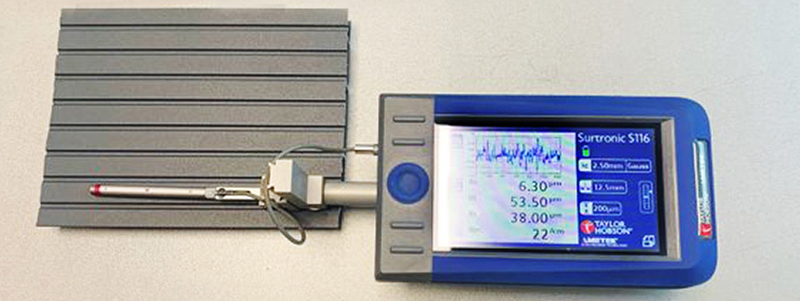
Macro and Micro Roughness Value Test (Rz) In accordance with BS7976
Surface Microroughness is a component of surface texture, it is generally determined by looking at deviations from the normal (mean line) profile of the surface. If these deviations are large the surface is rough, if they are small the surface is smooth. Using a tool with a stylus to measure these variations, a Rz value is able to be calculated. The Rz parameter is the mean value of the maximum peak to valley height of the profile within the sampling lengths.
This test has been performed to assess the Macro and Micro Roughness (Rz value) of the surface of the coating used on the AliDeck Aluminium Decking Range in order to ascertain Slip Potential against the following values:
Slip Potential Rz Microroughness
High Less than 10 µm
Moderate 10 – 20 µm
Low Greater than 20 µm
Test Result 1: 37 micrometres (Low Slip Potential)
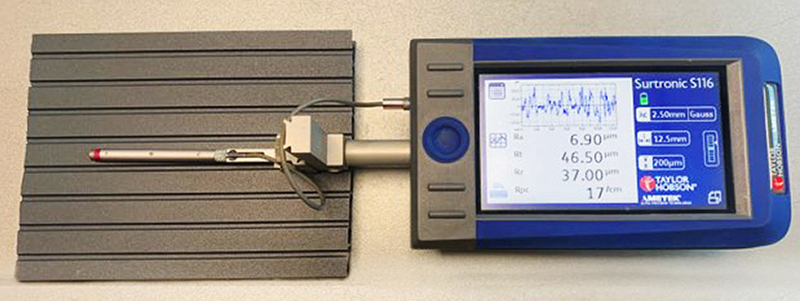
Test Result 2: 38 micrometres (Low Slip Potential)